









The Reference

Rulebook & Visual Glossary

The complete reference for Ndem Path — its visual language, its terms and engines, and the full rulebook across fourteen chapters.

I · Visual Language

The Symbols of the Path

Ndem Path speaks in symbols before it speaks in words. Learn the iconography of Force, Guard, and Trick, then the timing, class, and effect symbols that appear across every card.

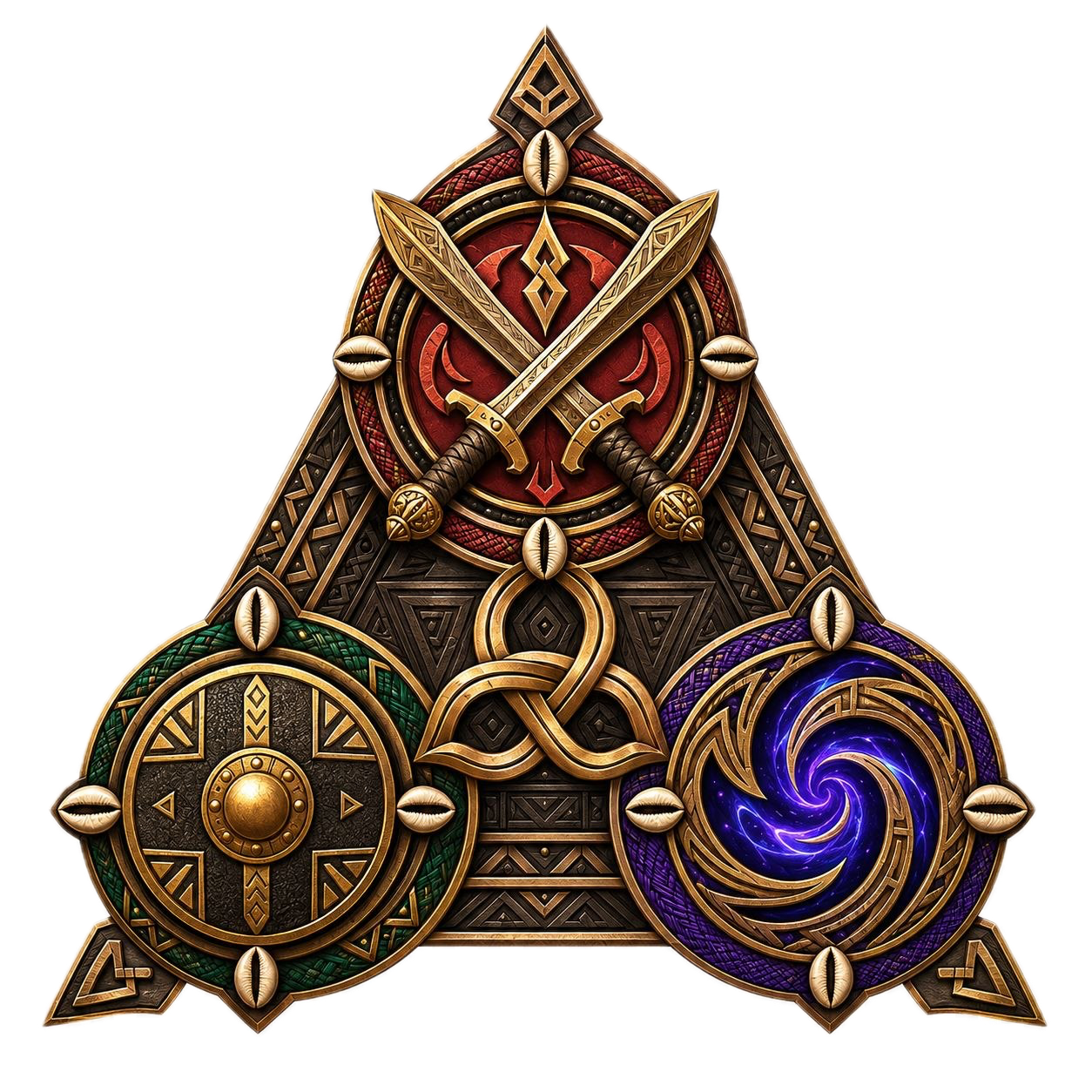
The Triad of Power — Force, Guard, and Trick bound in one triangular emblem
The Force sigil

Crossed swords

Force

Direct aggression, destruction, or overpowering.

The Guard sigil

Shield

Guard

Stability, protection, and resisting Force.

The Trick sigil

Spiral

Trick

Manipulation, swapping, and control.

A badger Ruhun of Force charging a cobra Ruhun of Guard across the Ridge

Force meets Guard upon the Ridge: the blades press, and the shield answers.

Timing Symbols

The Lightning — Triggered iconLightning — TriggeredImmediate activation upon playing or meeting a condition.
The Loop Arrows — Once per Round iconLoop Arrows — Once per RoundA tactical move requiring precise execution timing.
The Infinity — Unlimited iconInfinity — UnlimitedPassive environmental traits or persistent effects.

Class Icons

The Crossed Swords — Force iconCrossed Swords — ForceDirect aggression, destruction, or overpowering.
The Shield — Guard iconShield — GuardStability, protection, and resisting Force.
The Spiral — Trick iconSpiral — TrickManipulation, swapping, and control.

Effect Icons

The Effect iconEffectThe canonical Effect icon: an activated or applied spiritual effect.
The Up Arrow iconUp ArrowPower increase.
The Down Arrow iconDown ArrowPower decrease. With Lightning, a Negative Trigger: an immediate power loss or penalty when a condition is met.
The Skull iconSkullDestroy or discard.
The Circular Arrows iconCircular ArrowsMove or swap.

Term Icons

The Lightning iconLightningTriggered.
The Loop Arrows iconLoop ArrowsOnce per Round.
The Infinity iconInfinityUnlimited.
The Crossed Swords iconCrossed SwordsForce.
The Shield iconShieldGuard.
The Spiral iconSpiralTrick.
The Effect iconEffectActivated or applied effect.
The Up Arrow iconUp ArrowPower increase.
The Down Arrow iconDown ArrowPower decrease.
The Skull iconSkullDestroy or discard.
The Circular Arrows iconCircular ArrowsMove or swap.
The X iconXNegate.
The Eye iconEyeReveal or inspect.

Concept Sigils

The Sigils of the Path

The Anchoring sigil

Anchoring

An Offering anchored at a Shrine, altering it as its text describes.

The Attachment sigil

Attachment

An Ally attached to its host Spirit, modifying Power or granting effects.

The Sever sigil

Sever

The Law of Fragility: if the host Spirit is moved or destroyed, its attached Allies are instantly discarded.

The Ritual Intervention sigil

Ritual Intervention

Replacing an active Offering requires the Ritual Override Cost: discard one card from hand.

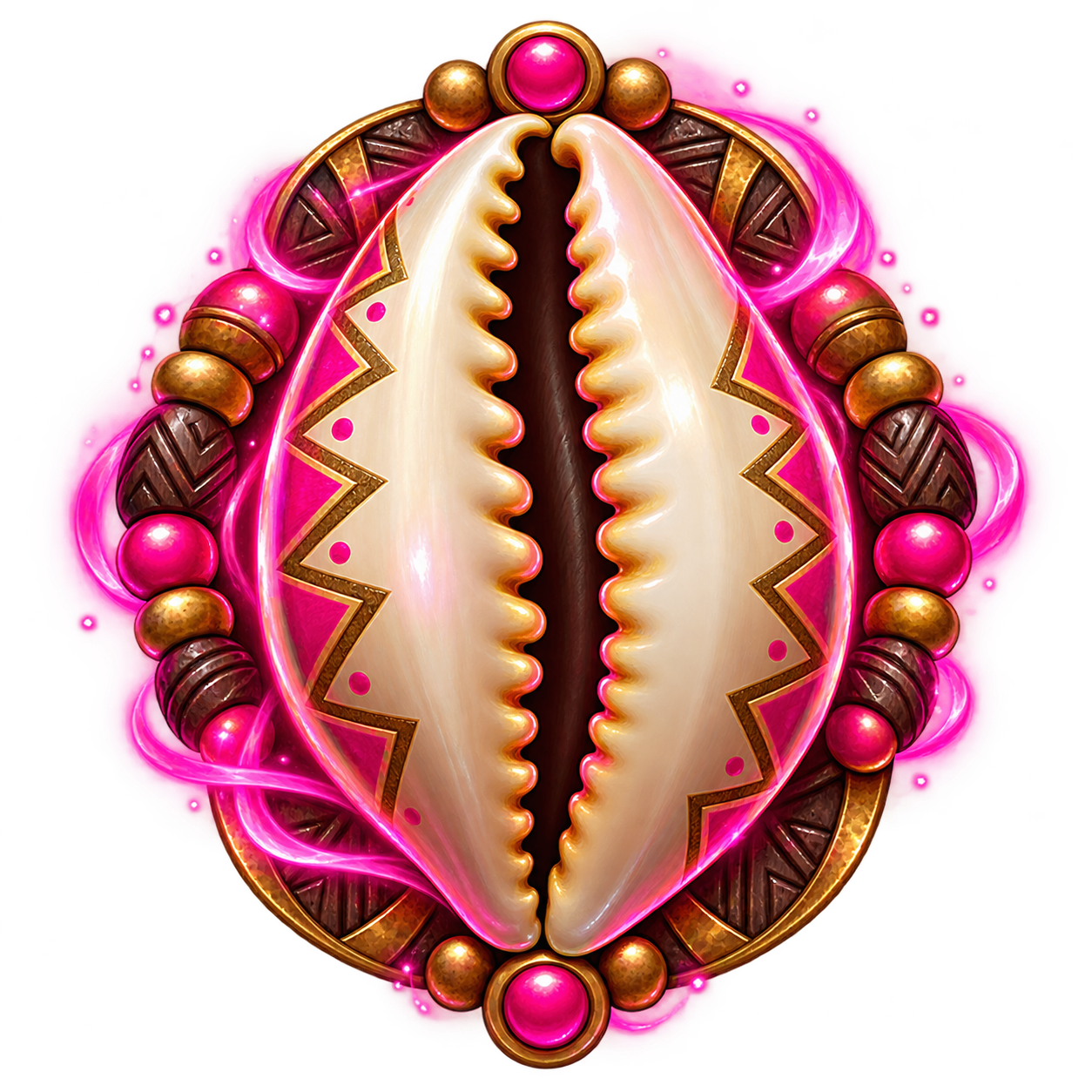
The Cowrie Shell sigil

Cowrie Shell

Favor tokens or Cowrie Shells mark each Shrine you secure.

Card Anatomy

How to read a Ndem Path card

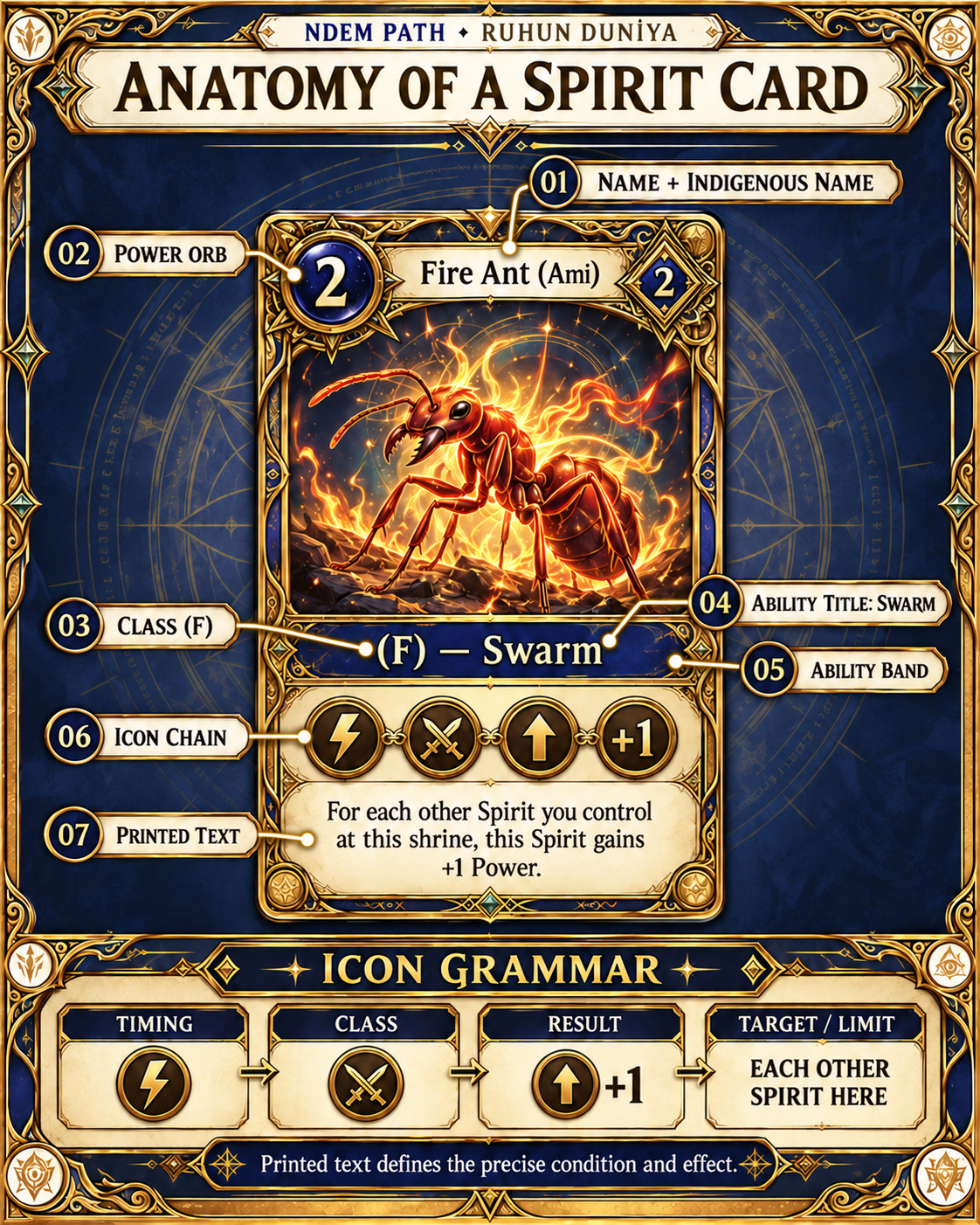
Anatomy of a Spirit Card — official Ndem Path infographic
  • 01

    Name + Indigenous Name

    The card's true name, joined with its name in the old tongue.

  • 02

    Power Orb

    The card's printed Power.

  • 03

    Class

    Force, Guard, or Trick — the Trinity of Power. Some cards have no printed class.

  • 04

    Ability Title

    The card's named ability, printed across the ability band.

  • 05

    Ability Band

    The colored strip that marks the card's class.

  • 06

    Ruhun Asé Chain

    Also called the Ability Icon Chain. Read in order: Timing → Class → Effect → Result → Target or Limit. ✨ is the canonical Effect icon.

  • 07

    Printed Text

    The card's exact ability wording — its timing, target, duration, conditions, and limits.

Ritual Intervention: Offerings (Ebu Emi)

The Offering color system: Gold/Teal is beneficial, Ocean Blue buffs and shields, Deep Red destroys, and Fuchsia suppresses. Limited to one Offering and one Trap per player per Shrine.

Summoning an Agbara

The Agbara summoning ritual: reveal and discard three Spirit cards from hand. Singular Focus applies.

Offerings, Traps & Bluffs

Rituals at a Shrine: Offerings are placed on the Shrine's tree emblem, Traps are hidden face-down and revealed on their printed trigger, and a Bluff is a hidden threat without asé.

At a Shrine — Spatial Ridging

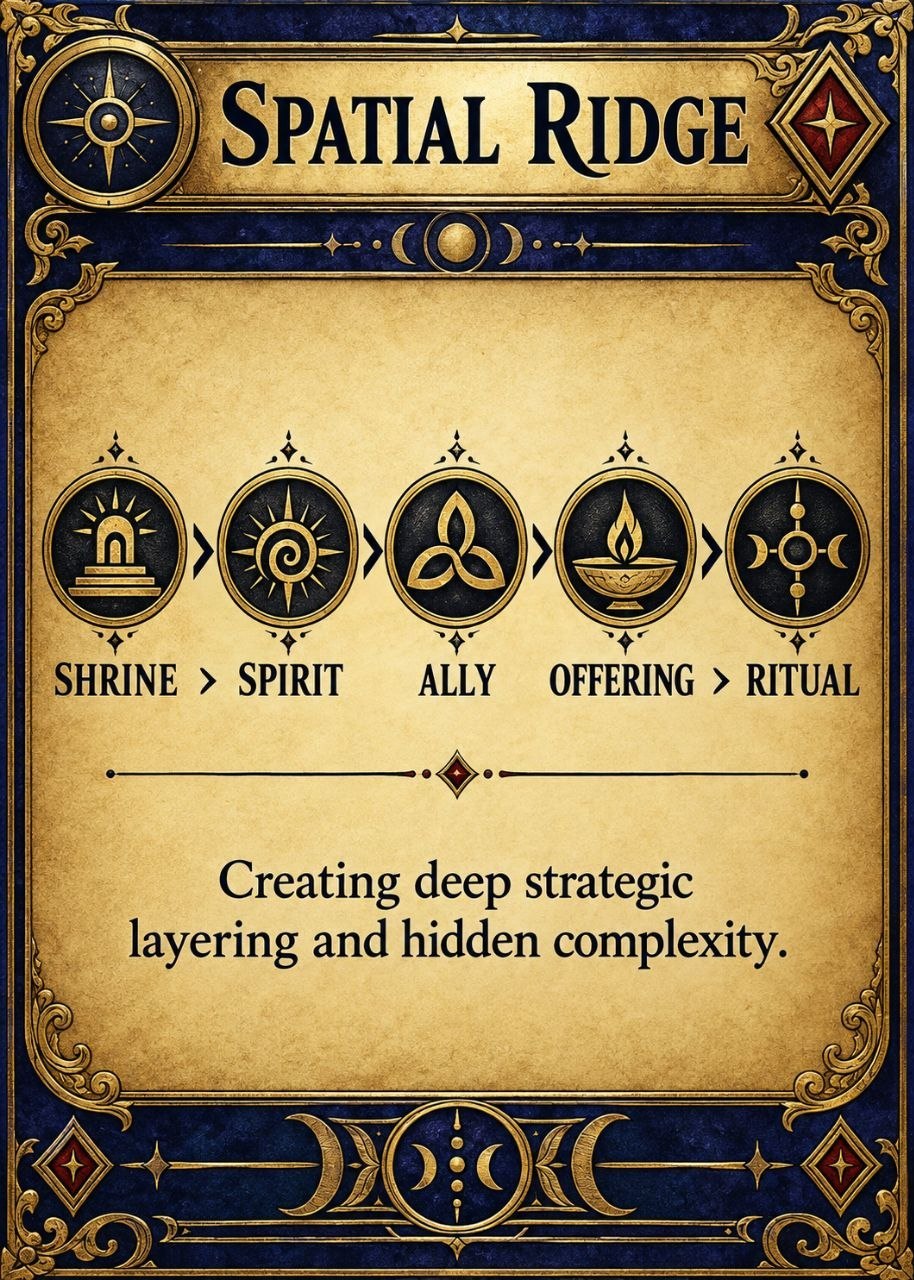
The stack at a Shrine: the Shrine is the base, the Offering anchors it, and the Spirit–Ally pair stands above it, with ritual connecting them all.

Anatomy of an Ally — Visual Standards

Visual standards for Ally (Na Ruhu) cards. Allies attach to Spirits and obey the Law of Fragility.

II · Terms & Engines

The Language of Play

These are the strategic concepts every walker of the Path should know. They describe how cards work together and how a match unfolds over time.

Spatial Ridge — the chain of power flowing from Shrine to Spirit, Ally, Offering, and Ritual

Engine

A self-sustaining set of cards that produces recurring advantage.

Synergy

When two or more cards naturally amplify one another without needing a full engine to connect them.

Combo

A sequence of cards whose effects chain together so each sets up the next, multiplying their individual power.

Payoff

The card or moment an engine builds toward — the single play that converts accumulated advantage into a winning position.

Tempo

The initiative — who is setting the terms of the exchange. A tempo advantage means your opponent is reacting to you.

Resource

Any asset — cards in hand, Spirits on the board, Asè — that fuels a player's actions.

Counterplay

A card or sequence that specifically answers an opponent's intended play, often using Guard or Trick at the right moment.

Board State

The complete arrangement of all Shrines, Spirits, Allies, and active effects at any moment in play.

III · Full Rulebook

The Complete Rulebook

Fourteen chapters, from the first turn to the final victory. Use the index to move between chapters.

Victory

Secure Three Shrines

Only the active player can score. Favor tokens or Cowrie Shells mark acquired Shrines; there is no separate Favor-token victory.

01

The Path Begins

Ndem Path is a shrine-control card game set across the realm of Duniya. Players play Spirits, attach Allies, and place Offerings to secure Bori Shrines. Its maxims: "Victory belongs to the Architect, not the Brawler" and "The path is never straight."

02

The Shrine Deck

Use a Bori Shrine Deck of 8–10 oversized cards. Each Shrine has a printed Threshold and, sometimes, a Shrine ability; several Shrines have no printed ability. The Grimoire does not fix how many Shrines are active at once.

03

Decks & Hands

Each Player Deck is 40–50 cards. Recommended distribution: Spirits 20–24, Allies 10–12, Offerings 8–10, and Agbara Legends 2–4. Maintain a 7-card hand standard — your Spiritual Bandwidth. The Grimoire does not specify deck sharing, a mulligan, first-player selection, replenishment timing, a discard-pile reshuffle, or an empty-deck loss rule.

04

Securing Shrines

Meet or exceed a Shrine's Threshold with your total Power there to secure it. Only the active player can score. Mark each acquired Shrine with a Favor token or Cowrie Shell. The Grimoire does not specify what happens to cards at a scored Shrine.

05

Your Turn

The Grimoire does not set a formal phase sequence or a fixed Spirit, Ally, or Offering play allowance. Play from hand and resolve each card using its exact ability wording for timing, target, duration, conditions, and limits. Phase sequences from older manuals are not used in this edition. The board itself is built by Spatial Ridging: the Shrine is the base, the Offering anchors it, and the Spirit–Ally pair stands above it — with ritual connecting them all.

06

Playing Spirits

Ruhun Duniya provide board power and host Allies, and multiple Spirits may stand at one Shrine. For Power, class, and ability, use each card's confirmed text — Elephant (Giwa), for example, is Power 9, Guard, and reads "This card cannot be moved."

07

Playing Allies

Na Ruhu are human Allies. They attach to Spirits to modify Power or grant effects, and they obey the Law of Fragility. Allies carry a printed Power modifier — for example Hunter +5, Watcher +4, Weaver +4, Protector +4, Healer +1, Messenger +1, Waylayer −3, Omo Ali −2. The Grimoire does not state a general one-Ally-per-host limit. Example: Elephant (Giwa) 9 + Hunter 5 + Watcher 4 + Weaver 4 + Healer 1 = 23 total Power.

08

Offerings, Traps & Bluffs

Interventions are placed on designated Shrine glyphs — Offerings on the Shrine's tree emblem — with one active Offering per Shrine, and one Offering and one Trap per player per Shrine. Removing or replacing an active Offering requires the Smudge Ritual: sacrifice a Spirit, Ally, or Trap at that Shrine. A Bluff cannot fuel a Smudge: if used to Smudge, discard the Bluff and the ritual is cancelled until next turn. Offerings designated as Traps use the Shadow Exception: they are played face-down and operate outside normal bandwidth limits in the Hidden State. Follow each Trap's confirmed trigger and resolution text. A Bluff is a face-down decoy; cards such as Oracle's Sight and The Palace refer to Bluffs directly.

09

The Trinity of Power

Spirits are organized by the Trinity of Power. Force (crossed swords) is direct aggression, destruction, or overpowering. Guard (shield) is stability, protection, and resisting Force. Trick (spiral) is manipulation, swapping, and control. Class roles describe interaction only — they do not add unstated power bonuses or immunities.

10

Reading Abilities

Each ability is shown as a Ruhun Asé Chain, read in order: Timing → Class → Effect → Result → Target or Limit. Lightning is Triggered: immediate activation on play or when a condition is met. Loop Arrows mean Once per Round. Infinity means Unlimited: passive or persistent. Lightning with a Down Arrow is a Negative Trigger: an immediate power loss or penalty. ✨ is the canonical Effect icon. Chains vary in length; follow each card's printed sequence.

11

The Law of Fragility

Allies are instantly discarded if their host Spirit is moved or destroyed; the Broken Chains glyph marks this bond. Specific card text overrides the general rule — Meerkat (Kurege) keeps one attached Ally when moved or swapped, and Traveler Ally moves to another Spirit when its host moves or is destroyed.

12

The Veil

The Veil is the barrier between the physical and spirit realms. Spirits may cross it; human Allies cannot.

13

Agbara & Victory

To summon an Agbara, reveal and discard three Spirit cards from hand. Singular Focus: the Agbara consumes your entire spiritual bandwidth and is the only card you may play that round. The Agbara Notch — shield-shaped indicators on Power 8–10+ cards — dictates Sacrifice Cost and Immunity Effects. There is no universal Force or Trick immunity; use each card's text. Victory: secure three Shrines.

14

Walking the Path

Ndem Path rewards foresight, restraint, and respect for the unseen. Victory belongs to the Architect, not the Brawler — for the path is never straight.

IV · Glossary

The Game Glossary

Every term a player needs, alphabetized and searchable. Hover or search to find the word you seek.

Agbara

High Rollers. To summon one, reveal and discard three Spirit cards from hand. Singular Focus applies: the Agbara is the only card you may play that round. There is no universal Force or Trick immunity; use each card's own ability text.

Agbara Notch

Shield-shaped indicators on Power 8–10+ cards that dictate Sacrifice Cost and Immunity Effects.

Ally

A human Ally card that attaches to a Spirit to modify Power or grant effects. Also known as Na Ruhu. Allies obey the Law of Fragility.

Asè

Primal spiritual energy and ancestral currency (also written Ase).

Bluff

A face-down decoy: a hidden threat without asé. A Bluff cannot fuel a Smudge; if used to Smudge, discard the Bluff and the ritual is cancelled until next turn.

Bori Shrine

A sacred gateway and scoring battlefield with a printed Threshold and, sometimes, a Shrine ability.

Broken Chains Glyph

The symbol of the fragile Ally–host bond. If the host Spirit moves to a different Shrine or is destroyed, the bond is severed and the Ally is instantly discarded.

Cowrie Shell

A marker for an acquired Shrine. Favor tokens may be used instead.

Duniya

The physical world where battles manifest.

Ebo Emí / Ebu Emí

Offerings and related ritual interventions, including traps, curses, and persistent environments. Both spellings occur in source materials.

Favor Token

A marker for an acquired Shrine. There is no separate Favor-token victory condition.

Force

Direct aggression, destruction, or overpowering. Emblem: crossed swords.

Guard

Stability, protection, and resisting Force. Emblem: shield.

Law of Fragility

Allies are instantly discarded if their host Spirit is moved or destroyed. Specific card text that overrides this rule takes precedence.

Na Ruhu

Human Allies. They attach to Spirits to modify Power or grant effects.

Offering

A ritual card placed on the Shrine's tree emblem. One active Offering per Shrine; a player is limited to one Offering and one Trap per Shrine.

Persistent Environment

An Offering or effect that continues to alter a Shrine as its printed text describes.

Player Deck

Each player's deck of 40–50 cards. Recommended: Spirits 20–24, Allies 10–12, Offerings 8–10, and Agbara Legends 2–4.

Ritual Override Cost

The cost of removing or replacing an active Offering, paid through the Smudge Ritual.

Ruhun Asé

Spirit Abilities.

Ruhun Asé Chain

Also called the Ability Icon Chain. The ordered icon sequence that communicates a card's ability: Timing → Class → Effect → Result → Target or Limit. Replaces the older terms Icon Chain and Icon Equation.

Ruhun Duniya

Animal Spirits. They provide board power and host Allies. Multiple Spirits may be present at one Shrine.

Shadow Exception

Offerings designated as Traps are played face-down and operate outside normal bandwidth limits in the Hidden State.

Shrine

Short for Bori Shrine.

Shrine Deck

The Bori Shrine Deck: 8–10 oversized Shrine cards.

Singular Focus

Summoning an Agbara consumes your entire spiritual bandwidth: it is the only card you may play that round.

Smudge Ritual

Sacrifice a Spirit, Ally, or Trap at a Shrine to remove or replace its active Offering. A Bluff cannot fuel a Smudge: if used to Smudge, discard the Bluff and the ritual is cancelled until next turn.

Spatial Ridging

The stacking structure at a Shrine: the Shrine is the base, the Offering anchors it, and the Spirit–Ally pair stands above it. The Ridge carries movement between Shrines, and ritual connects them all.

Spirit

A Ruhun Duniya — an Animal Spirit with a Power value and, on most cards, a class of Force, Guard, or Trick.

Spiritual Bandwidth

The 7-card hand standard. Summoning an Agbara consumes it entirely for the round.

The Veil

The barrier between the physical and spirit realms. Spirits may cross; human Allies cannot.

Threshold

The number printed on a Shrine, also called its Target Value. Meeting or exceeding it with your total Power at that Shrine secures it. Only the active player can score.

Trap

A face-down card — an Offering or certain Allies — that resolves by its own confirmed trigger and resolution text.

Trick

Manipulation, swapping, and control. Emblem: spiral.

Trinity of Power

Force, Guard, and Trick — the three classes that organize Spirits. Class roles describe interaction; they add no unstated power bonuses or immunities.